
Stari Grad, Old Town Budva
It was hard to appreciate Montenegro in the rain. But its mountains, fortified towns like Budva and coastline were enchanting viewed through the mist.

St. Ivan (St. John) Catholic Church
The belfry you see above is that of St. Ivan’s. It has been a landmark since 1867. The current church is from the 15th century. I was amazed by the fresco of St. John on the altar wall. It’s a sharp contrast to the austere white walls. *Picture taking is not allowed.
Citadela or St. Mary’s Fortress
The Citadel’s existing form can be attributed to the Austrian Hungarian rule in the 19th century which lasted a 100 years. The Austrian army built their barracks inside the Citadel. There’s a small entrance fee to the Citadel.

Narrow passageways of Budva
The old town of Budva is surrounded by medieval stone walls built by the Venetians during heir 400-year rule to protect Budva (known then as Budua) against Ottoman incursions. Structures within its core are made of stone as well. The alleys are sparkling clean and glisten from the rain.
The remains of the northern tower of the Citadel built during the Venetian occupation.
There are concerts and art performances held during the summer in the Old Town, hence this grandstand in the foreground. Imagine the spectacular views from here of the Adriatic Sea and the surrounding medieval buildings.

Montenegro was hit by a 7.0 (on the Richter scale) earthquake in 1979 and many towns on the southern Adriatic including Budva were devastated. It took many years to restore the old town to its original shape.
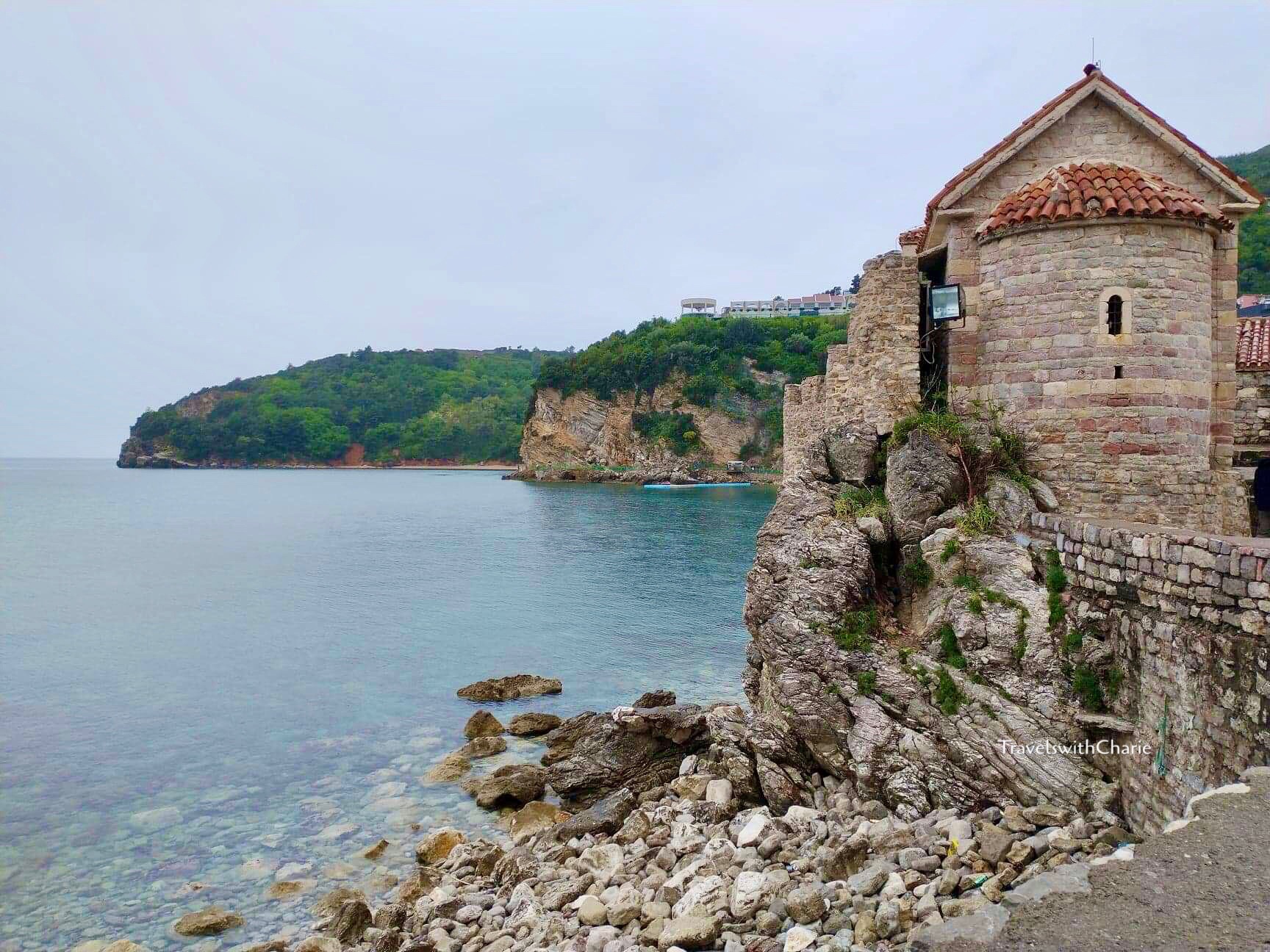
Church St. Sava the Sanctified, 12th century, Orthodox

Church of the Holy Trinity, from 1804
The predominant religion in Montenegro is Eastern Orthodox. The Church of the Holy Trinity is an Orthodox church. Its interior is decorated with beautiful frescoes and icons.

Fresco of Jesus and the Apostles, Church of the Holy Trinity

Christ the Pantocrator, dome of the Holy Trinity Church
Every Orthodox Church has the image of the Pantocrator or the ruler of all.

Sveti Nikola Island
It’s possible to go to Sveti Nikola island (also known as Hawaii Island) by taking a water bus from the promenade. There are restaurants and facilities on the island and a beach of its own.

Budva Riviera
Restaurants dot the beachfront leading to the Old Town.
Marina
Wealthy Russians have invested heavily in Budva and you’ll see a lot of construction going on around the city. The marina is full of luxury yachts purportedly owned by these same investors. The Budva Riviera has attracted many Eastern European visitors in the past.

I had to stop and smell the flowers. This tree was right on the waterfront beside a busy restaurant. It reminded me of jasmine and childhood.
How to get there:
Super Tours has full day tours to Montenegro from Dubrovnik. This tour covered Perast, Kotor and Budva. We were given enough time to explore these cities on our own. There were 36 people in our group and like all bus tours of this size, it took us longer to pass through two border patrol stations. Having joined a small group tour to Bosnia Herzegovina two days later, I highly recommend sightseeing with a smaller group of people. https://www.supertours.eu/excursion/the-best-of-montenegro/
*****
Images by TravelswihCharie