
Oh, the books you’ll read

Long Room, Trinity College Library
“The library card is a passport to wonders and miracles, glimpses into other lives, religions, experiences, the hopes and dreams and strivings of ALL human beings, and it is this passport that opens our eyes and hearts to the world beyond our front doors, that is one of our best hopes against tyranny, xenophobia, hopelessness, despair, anarchy, and ignorance.” Libba Bray, author
Address: Trinity College, Dublin, Ireland.

OBA Library of Amsterdam
“Whatever the cost of our libraries, the price is cheap compared to that of an ignorant nation.” Walter Cronkite, American broadcast journalist
Address: Oosterdokskade 143 (east of Amsterdam central station). Has a café.

University of Zurich Law Library
“When in doubt, go to the library.” J.K. Rowling, author 
 Address: Rämistrasse 74. Has a café.

Helsinki Central Library Oodi
“I have found the most valuable thing in my wallet is my library card.” Laura Bush, Librarian and wife of President George W. Bush 
Address: Töölölahdenkatu 4 (across from the Musikhuset). Has a restaurant, Fazer Food & Co.

Rijksmuseum Research Library
“People can lose their lives in libraries. They ought to be warned.” Saul Bellow, author 
Address: Rijksmuseum. Museumstraat 1. There’s a café in the Atrium called simply, The Café, and three espresso bars.

Stuttgart Stadtbibliothek
“I’ve always imagined that Paradise will be a kind of a library.” Jose Luis Borges, Argentinian writer and poet
Address: Mäilander Platz 1. Has a café, LesBar Café.

François Mitterrand Library
“The only thing you need to know is how to get to the library.” Albert Einstein
Address: Quai François Mauriac. Has a restaurant.
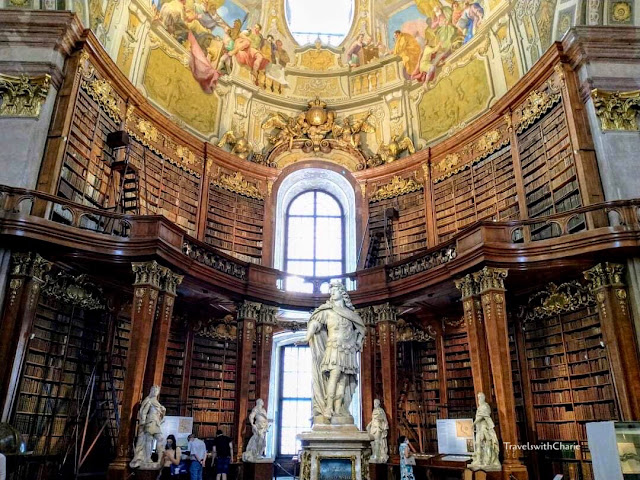
Prunksaal or State Library of the Austrian National Library
“I had found my religion; nothing seemed more important to me than a book. I saw the library as a temple.” Jean Paul Sartre
Address: Josephplatz 1, Vienna

Library of the Marquis of Cerralbo
“To add a library to a house is to give that house a soul.” Cicero
Address: Cerralbo Museum, Calle de Ventura Rodriquez, 17 Madrid, Spain

National Library of Latvia
“Reading brings us unknown friends.” Honoré Balzac
Address: Mūkusalas iela 3, Zemgales priekspilsēta, Riga, Latvia

Royal Portuguese Reading Room
“I couldn’t go to college, so I went to the library three times a week for 10 years.” Ray Bradbury
Rua Luis de Camoes, 30 Rio de Janeiro, Brazil

National Library of Kosovo
“I always tell people that I became a writer not because I went to school but because my mother took me to the library. I wanted to become a writer so I could see my name in the card catalog. Sandra Cisneros
Beside the University of Pristina, Pristina, Kosovo

This post was originally published on: August 16, 2020
Last Updated: July 29, 2024

Stay connected

*****

Images by TravelswithCharie


Popular posts from this blog

Brașov was once called Stalin City

White Tower Brașov is a city nestled in the Carpathian Mountains in Transylvania. Remnants of its medieval fortifications and bastions are added attractions to this buzzing city. The White Tower along with the Black Tower are two of the remaining watchtowers still visible today. During the Communist period,  Brașov  was called Orasul Stalin or Stalin City after the Soviet leader, Joseph Stalin. Black Church This is such a storied Gothic church which was originally the Catholic Church of St. Mary before it was converted to a Lutheran Church. It was believed to have been affected by fire in 1689 which blackened its exterior walls and roof. But a new 21st century study reveals that this wasn’t the case at all. The only reason for its blackened state according to the study is environmental pollution caused by the industrialization of Brasov in the 19th century. The walls have since been cleaned but there are traces of black spots on the roof.  Republicii Street This long pede...

The Gold of Ancestors: Pre-Colonial Philippine Treasures

Openwork basket, Surigao, 10th-13th century What a wonderful surprise this exhibition is! These gold objects, about a thousand of them, add a rich layer to Philippine history. This collection which was found in various sites in the Philippines, date back to the 10th-13th centuries. It demonstrates the well developed culture of pre colonial Philippines which the Spaniard, Antonio Pigafetta, recorded in 1521 when Ferdinand Magellan landed in the islands. A thriving interchange between the Philippines and its Asian neighbors existed prior to the arrival of Magellan as attested by some of these gold accouterments which show for example, images from Hindu mythology. The motifs and curvilinear ornamentation of the openwork basket (shown above) intimate Chinese designs found in their ceramics and textiles.  Torso ornament, 10th-13th century Weighing four kilos of gold, this sash is worn across the chest similar to the  upavita (sacred thread)  style in Hindu culture. This sash w...

The Art of Carlos Botong Francisco - Progress of Medicine in the Philippines

Pre-colonial period Pag-unlad ng Panggagamot sa Pilipinas (The Progress of Medicine in the Philippines) is a group of four large-scale paintings depicting healing practices in the Philippines from pre-colonial times to the modern period. Carlos Botong Francisco was commissioned in 1953 by  Dr. Agerico Sison who was then the director of Philippine General Hospital (PGH) together with   Dr. Eduardo Quisumbing of the National Museum, Dr. Florentino Herrera, Jr. and Dr. Constantino Manahan. These oil on canvas paintings measure 2.92 meters in height and 2.76 meters in width (9.71 ft x 8.92 ft) and were displayed at the main entrance hall of PGH for over five decades. Owing to its location, the artworks were in a state of "severe deterioration" at the beginning of the 21st century from exposure to heat, humidity, dirt, dust, smoke, insect stains, grime, termites and an oxidized synthetic resin used in an earlier restoration. These canvases were restored three times, the last was...